
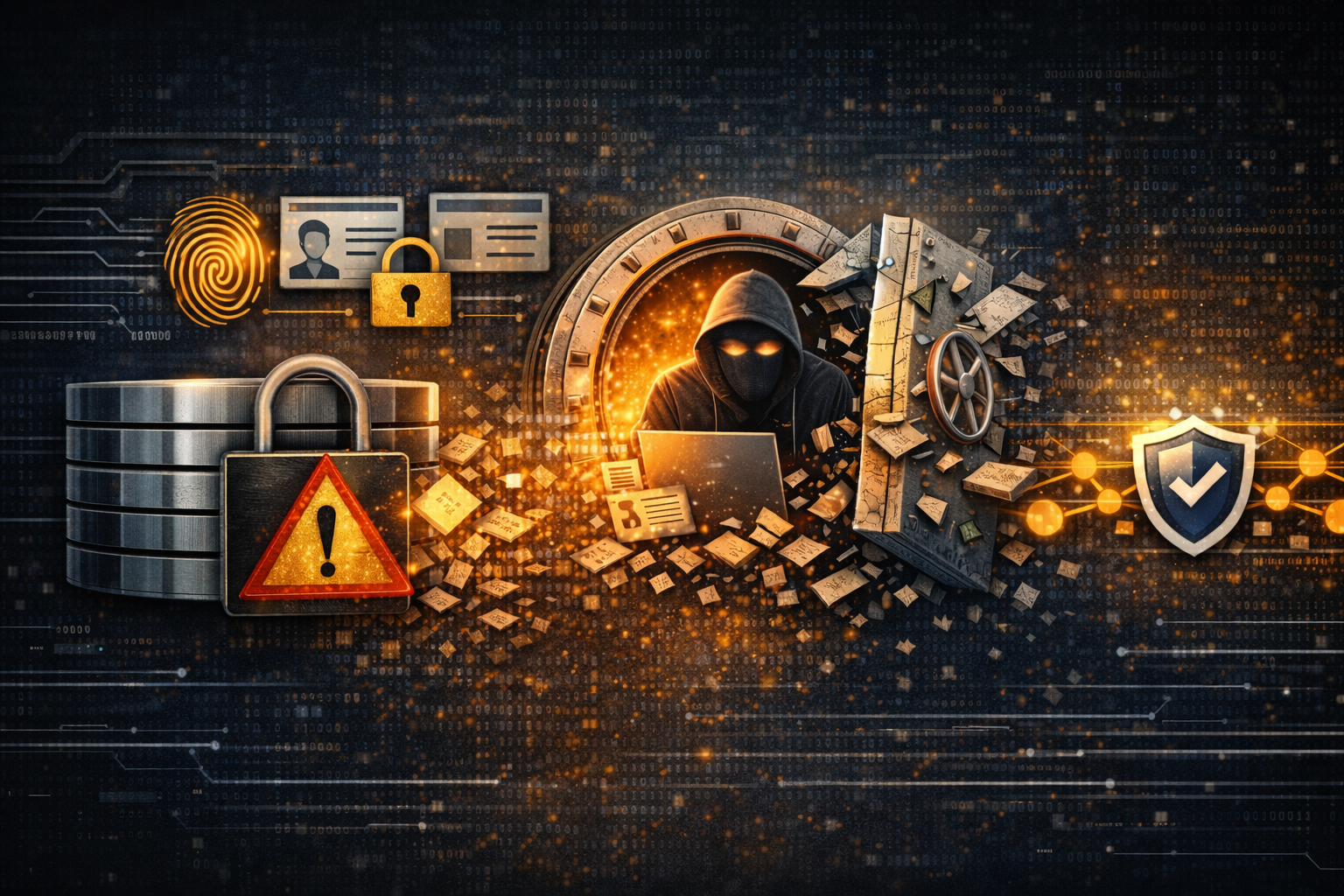
Your data is the new gold.
And today, most of it is stored in one vault.
Centralized identity databases were built for convenience—one system, easy access, faster verification. But the same architecture that promises efficiency has quietly become one of the biggest security risks of the digital age.
The Problem with Centralized Identity Systems
Centralized systems collect and store millions of identities in a single database. On the surface, this seems practical. In reality, it creates a single point of failure.
When one system holds everything, one breach exposes everyone.
This is not hypothetical. A majority of large-scale data breaches globally originate from centralized databases, where attackers gain access to massive volumes of sensitive personal information in one strike.
Convenience Comes at a Cost
Centralized identity systems are designed to make verification easy:
- One database
- Faster lookups
- Unified access
But this same simplicity works in favor of attackers.
Once inside, there are no natural barriers—identity data can be copied, stolen, and misused at scale. The larger the database, the higher its value, and the more attractive it becomes as a target.
Why Identity Data Is Different from Passwords
When a password is compromised, it can be changed.
When identity data is leaked, the damage is permanent.
Personal data—faces, IDs, biometric attributes—cannot be reset, revoked, or replaced. Once exposed, it can be reused indefinitely for fraud, impersonation, and surveillance.
This makes centralized identity leaks far more dangerous than traditional security breaches.
The Shift Toward Privacy-First Identity Systems
Modern identity verification must move away from data hoarding and toward data minimization.
Privacy-first, decentralized approaches change the model entirely:
- Identity is verified without storing everything in one place
- Sensitive data is not exposed during routine verification
- Systems are designed to validate authenticity, not collect information
Instead of building larger databases, the focus shifts to secure verification at the moment of access.
How DigiSuraksha Rethinks Identity Security
At DigiSuraksha, privacy is not an afterthought—it is the foundation.
Rather than relying on centralized repositories of personal data, DigiSuraksha enables identity verification through tamper-proof, encrypted, and privacy-first mechanisms that significantly reduce exposure risk.
By limiting raw data storage and embedding security directly into the verification process, DigiSuraksha ensures trust without creating high-value data vaults vulnerable to mass compromise.
Why the Future of Trust Is Decentralized
As digital identity adoption grows across enterprises, institutions, and public systems, the risks of centralized storage will only increase.
The future belongs to identity systems that:
- Eliminate single points of failure
- Protect personal data by design
- Verify identity without excessive data retention
- Prioritize trust, security, and privacy equally
Conclusion
Centralized identity databases promise convenience—but deliver risk.
In a world where identity theft is irreversible, security can no longer depend on massive data vaults. It must be built into the architecture itself.
Tamper-proof. Privacy-first. Built for the future of trust.
That is the DigiSuraksha approach.