
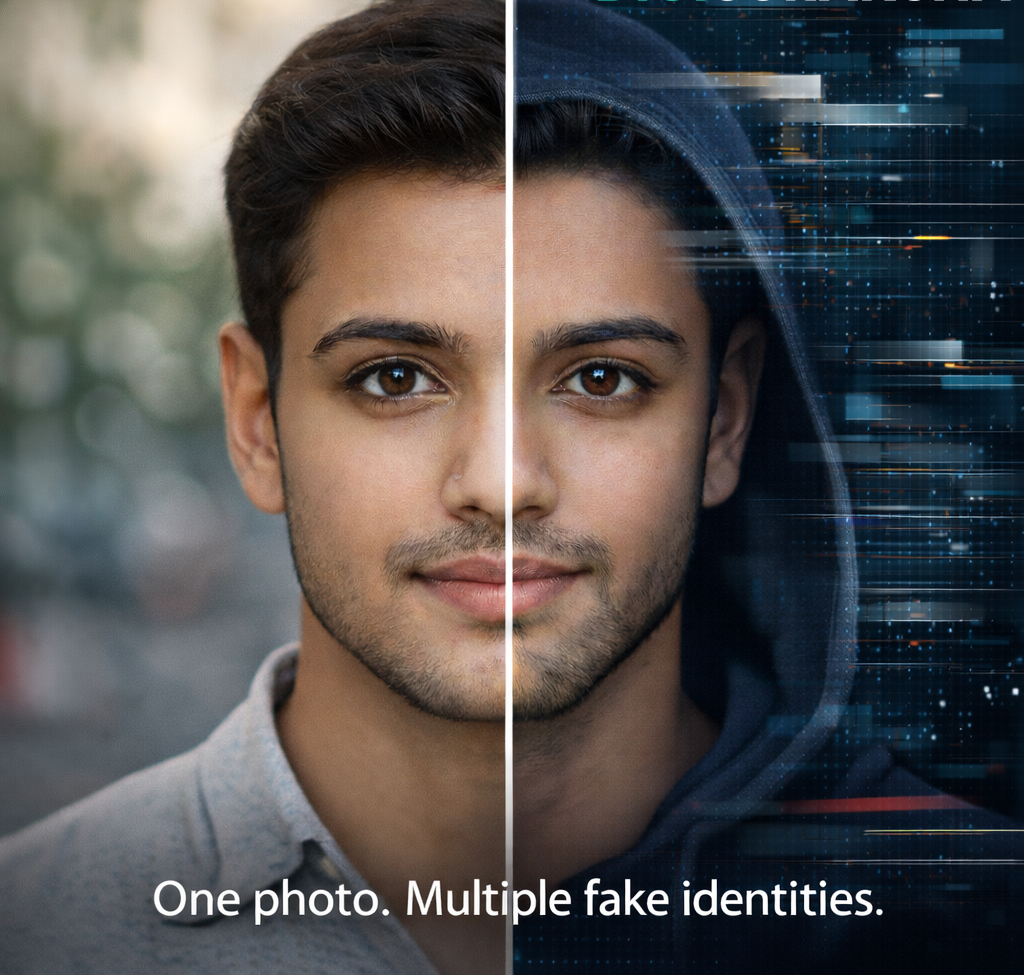
Deepfakes are no longer a future risk—they are present-day weapon.
By 2026, AI-generated faces are realistic enough to bypass outdated identity systems that still depend on visual similarity, static images, or basic face matching.
In this new reality, identity verification must assume that faces can be faked. The only systems that will survive are those built to verify presence, intent, and cryptographic biometric intelligence—not just appearance.
The Deepfake Problem Is Structural, Not Cosmetic
Modern deepfakes are not just better images. They are algorithmically generated identities designed to deceive systems that trust what they see.
This enables:
- Impersonation during digital onboarding
- Unauthorized access to secured zones, events, and institutions
- Election and institutional fraud
- Scalable identity misuse using AI-generated media
Any system that accepts a face at face value is already compromised.
Why Traditional Face Verification Is No Longer Enough
Legacy face verification systems were built to answer one question:
Do these two faces look alike?
Deepfakes exploit this limitation.
A convincing synthetic face can still match. A replayed video can still pass. A static selfie can still deceive. Visual similarity does not equal identity authenticity.
In 2026, face matching without intelligence is a security illusion.
From Face Images to Face Intelligence
The future of identity verification lies in how a face is represented, not how it looks.
Instead of treating a face as an image, DigiSuraksha converts a human face into a secure digital signature through a patented process. Facial features are transformed into mathematical equations, which are then embedded into a 256-bit encrypted QR code. This creates a tamper-proof identity layer that cannot be reverse-engineered into a photograph.
No raw facial image is relied upon during verification—only encrypted biometric intelligence.
Why This Approach Breaks Deepfake Attacks
Deepfakes are designed to fool visual systems.
They fail against mathematical identity.
DigiSuraksha operates as a multi-layered, face-embedded QR identity system. Even if an attacker attempts to replicate a single element—such as copying the QR code or mimicking facial parameters—they cannot bypass verification. Identity is confirmed only when QR encryption, facial equations, and real-time liveness detection are validated together.
A deepfake may look human—but it cannot behave like one, think like one, or pass live biometric scrutiny.
Real-Time Verification: Where Presence Matters
During verification, DigiSuraksha does not trust stored data alone. It validates:
- Live face capture against encrypted face vectors
- Real-time liveness to confirm physical human presence
- One-person–one-ID enforcement
- Session-level and device-level integrity
This ensures that identity is proven at the moment of access, not assumed from previously stored images.
Security Without Sacrificing Privacy
Advanced security must not compromise individual rights.
DigiSuraksha is built on a privacy-first architecture:
- Consent-based identity verification
- No dependency on raw facial image storage
- Encrypted biometric descriptors only
- Compliance with Indian IT and data protection standards
Trust is protected not just through security—but through responsible design.
The End of Trust-by-Image
Deepfakes will continue to evolve.
Systems built on images will continue to fail.
The future belongs to identity platforms that:
- Treat faces as biometric intelligence, not visuals
- Use encryption instead of exposure
- Verify presence, not similarity
Assume fraud—and design beyond it
Conclusion
Deepfakes don’t defeat identity systems.
Outdated identity systems defeat themselves.
By converting faces into encrypted mathematical signatures, embedding them in tamper-proof QR codes, and validating identity through real-time liveness, DigiSuraksha is built for the deepfake era—not the image-based past.